Masterpiece — About the Tabletop Hearth
À propos de l’œuvre maîtresse : le foyer de table
陶管四千年記 文明の影に沈んだ素材
Ⅰ. Le Matériau Oublié — Quatre Mille Ans de Silence
(La traduction française se trouve ci‑dessous.)
Clay Pipes: Four Thousand Years — The Material That Sank into the Shadow of Civilization
Civilization is always told from the side that faces the light. The names of kings, the names of cities, the names of monuments. Yet the materials that supported the roots of civilization were always placed where the light could not reach. Clay pipes were one of them.
When humanity began to build cities, the first thing it needed was not temples, nor walls, nor weapons— but vessels for handling water.
Clay pipes were born as a material in the shadow of civilization.
Mesopotamia — At the Mud‑Scented Bottom of Civilization
Around 2000 BCE, in the cities of Ur and Uruk, fired‑clay pipes ran quietly along the bottoms of mud‑scented drainage channels.
Their names were never carved into royal inscriptions, nor painted onto temple walls. They simply carried water so the cities would not rot.
People walked above the clay pipes, and the clay pipes remained silent beneath them.
The prosperity of civilization was supported by the silence of materials working in the darkness underground.
Egypt — Clay Pipes That Supported the Breath of the Nile
The flooding of the Nile brought both abundance and destruction.
In ancient Egypt, fired‑clay pipes were used to control the water of the farmlands.
Temple walls depicted kings and gods, but never the clay pipes that guided water at their feet.
Civilization does not speak of its own roots.
Indus — In the Silence of Lost Cities
At the ruins of Mohenjo‑Daro and Harappa, highly advanced drainage systems have been excavated. Yet the material at their ends is scarcely recorded.
Fired‑clay pipes remained quietly underground even after the civilization perished.
People’s lives disappeared, their languages disappeared, the names of their gods disappeared.
But the clay pipes continued their silence underground.
The shadow of civilization lasts longer than civilization itself.
China — A Material Placed Between Prayer and Fear on the Loess Plains
The Yellow River was “the mother of Chinese civilization,” and at the same time “its threat.”
To manage the water of the farmlands, fired‑clay pipes were laid.
Fearing floods, fearing drought, people fired earth to control water.
Clay pipes were a material placed between the prayers and fears of farmers.
Not an object of prayer— but a material that supported prayer.
Greece — The Unnamed Material Working in the Shadow of Philosophy
In the Greek city‑states, fired‑clay pipes were used to guide water to public baths and fountains.
Philosophers spoke of “what it means to be human,” poets sang of “what beauty is.”
But no one spoke of the material that carried water through the cities.
Civilization records only what is beautiful.
Rome — Fired‑Clay Pipes Working Beneath the Splendor of Stone
The aqueducts of the Roman Empire are remembered as magnificent stone arches.
Yet at their ends, receiving the water and distributing it throughout the city, were not stones— but fired‑clay pipes.
Roman clay pipes quietly bore the weight of water beneath the noise of the empire.
No one knew their names, yet they sustained the life of the empire.
The light of civilization does not illuminate the shadow of its materials.
Arab World — The Silent Material That Protected Water in the Desert
In desert cities, water was life itself.
In some regions, fired‑clay pipes were used to support underground water channels (qanats).
The desert night is quiet, and the silence of clay pipes resembled that quiet.
Materials that carry water never have a voice.
Europe, Middle Ages — The Forgotten Material Beneath the Cobblestones
In medieval towns, clay pipes were laid beneath the cobblestones.
Fearing plague, seeking to keep foul water away, people fired earth to make pipes.
But only the beauty of the cobblestones was remembered. The material working beneath them was not.
Clay pipes protected the health of the towns, yet remained absent from their memory.
Africa — A Material That Guided Water Across Dry Land
In ancient North African cities, fired‑clay pipes were used for irrigation.
In the dry wind, clay pipes protected the pathways of water.
But the dry land does not record the names of materials.
Southeast Asia — The Unnamed Material Supporting the Water of Terraced Fields
Terraced fields are beautiful. Yet behind that beauty, some regions used fired‑clay pipes to guide water.
Beautiful landscapes are recorded. The names of materials are not.
Central and South America — The Material Working in the Shadow of Ancient Waterways
In the highlands of the Andes, traces remain of fired‑clay pipes used to manage water.
Civilizations perished, temples collapsed, people’s memories faded.
But clay pipes continued their silence underground.
Hokkaido — The Material That Sank into the Soil of the Frontier
And then, 150 years ago, in Hokkaido.
The soil of the frontier was heavy, the water was cold, the farmland was wet, and the towns had yet to take shape.
Beneath that earth, countless clay pipes were laid.
Drainage for fields, pastures, sewage, factory runoff— none of it was recorded, none of it photographed, yet all of it worked silently underground.
Stone warehouses survived. Brick buildings survived. But clay pipes did not.
Materials that work as the shadow of civilization are always forgotten.
Modern Era — The Last Living Mainstream in the World
By the mid‑20th century, the world abandoned earthen materials in the name of rationality.
PVC was light, cheap, fast, and easy to replace. Concrete pipes were convenient for cities handling large volumes of water.
Yet across the world’s farmlands and in the corners of its towns, clay pipes still worked quietly.
In rural America, at the edge of an old field behind a grandfather’s house, rainwater would disappear as if the ground were breathing. No one knew why. A clay pipe lay sleeping underground.
In old German pastures, snowmelt would slowly vanish in spring. The caretaker simply said, “People back then were wise.” Clay pipes lay beneath his feet.
In French farmhouses, a grandmother would smile, “This field drains well.” No one explained why. A fired‑clay pipe was quietly breathing underground.
People around the world walked above clay pipes, lived above them, grew up above them, grew old above them.
Yet no one knew their name.
Clay pipes were overwhelmingly superior in durability, but their quiet strength was drowned out by the wave of rationality.
In North America, in Europe, in Asia, the clay pipes that once supported civilization were called “old materials,” stacked as mere waste.
After four thousand years of silence, clay pipes were finally treated as something unnecessary.
But one corner of the world map was different.
The northern edge of Japan— Hokkaido.
Only its kilns continued firing unglazed clay pipes for farmland drainage.
As clay pipes disappeared across the world, Hokkaido’s pipes alone possessed monstrous strength and remained quietly as the last stronghold.
Thick‑walled, resistant to frost heave, with extraordinary bending strength, enduring decades underground, their porous clay breathed water, their ventilation kept soil from rotting— their performance surpassed every material swallowed by rationality.
The true mainstream of clay pipes, forgotten by world civilization, survived only in the cold land at the edge of the world.
It was not a miracle. It was simply the quiet, steady work of people who preserved the culture of earth and fire.
And the material continued its silence underground.
Unnamed, unpraised, working as the shadow of civilization, quietly, certainly, breathing in the soil of Hokkaido.
The last living mainstream had not ended.
The material had waited four thousand years underground to be picked up by a certain man.
A Man Picks Up the Clay Pipe
One day, a man picked up an old clay pipe. Unearthed from the ground, it smelled of soil, held the memory of water, and carried the temperature of civilization’s shadow.
The man quietly gazed at a material no one had cared for.
“This will become a vessel that supports fire.”
He spoke words no one had ever spoken.
Clay pipes were born to carry water. But the man entrusted them with fire.
A material that had remained silent underground for millennia received, for the first time, the breath of flame.
The True Nature of Clay as a Vessel for Fire
Clay does not fear fire. The memory of firing remains at its root.
Clay regulates the breath of flame. Its layers of stored heat receive the strength and weakness of fire.
Clay creates the wind that keeps flame alive. Its breathability prevents the flame from raging, letting it burn quietly.
When a candle is lit, the flame grazes the inner wall of the pipe, the stored‑heat layer glows faintly red, and the wind of ventilation turns that glow into a gentle shimmer.
The color born in that moment is the legendary shōjōhi.
A material born to carry water was, in truth, perfect for carrying fire.
The fact is so quiet, so beautiful, it feels like a secret the material had kept for four thousand years.
The Moment the Material Wept
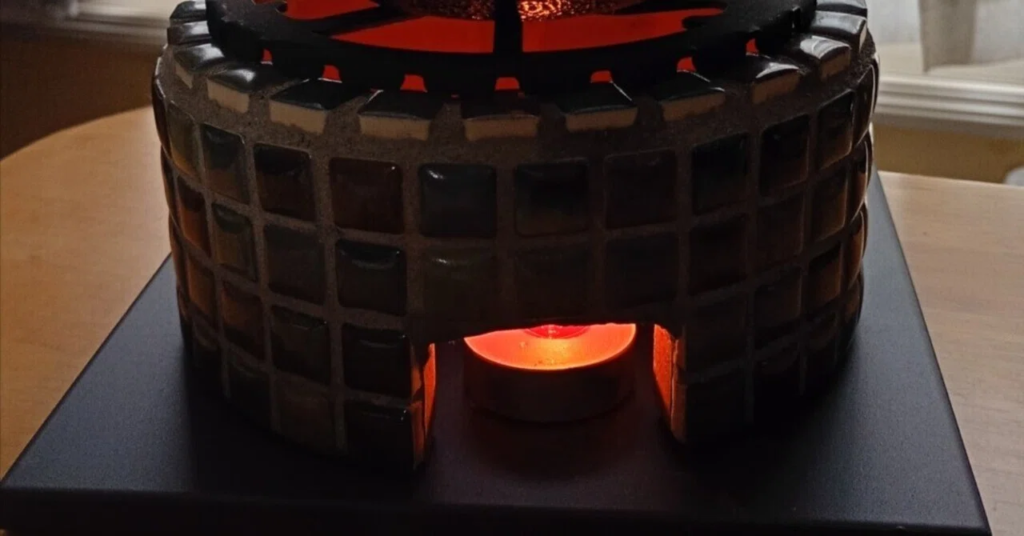
The man lit the hearth. The blue flame of solid fuel flickered quietly between the tiles.
Its shimmer felt like it was breaking four thousand years of silence.
Clay was born in fire, raised with water, forgotten underground, worked in the shadow of civilization, and never had its name called.
But now, as a vessel for fire, it breathed beautifully on a tabletop.
The man slid the lid of a steaming earthen pot, gazing at a single cup of freshly cooked rice.
The steam touched the flame of the hearth and swayed softly.
The sway felt as if the material itself were shedding tears.
“You supported civilization all this time. From now on, you will also become a vessel for fire.”
The man tasted a sip of freshly brewed coffee and whispered:
“This flame waited four thousand years underground to illuminate the quiet parts of someone’s life.”
Clay, as a vessel for fire, was quietly, certainly, seeing the light of day.
ToEbe. Toward the quiet spaces.
Afterword
The hearth (the mini‑kamado) is not merely a tool for fire.
It is a vessel that brings quiet, the culture of flame, and four thousand years of material history into everyday life.
And it gently affirms the quiet parts of your own life— the efforts no one knew, the feelings that never became words.
文明は、光の側だけで語られる。
王の名、都市の名、建築の名。
だが、文明の根を支えた素材は、
いつも光の届かない場所に置かれてきた。
陶管もそのひとつだった。
人類が都市をつくり始めたとき、
最初に必要とされたのは、
神殿でも、城壁でも、兵器でもなく、
水を扱うための器だった。
陶管は、文明の影として生まれた素材だった。
メソポタミア 泥の匂いのする文明の底で
紀元前2000年頃、ウルやウルクの街では、
粘土を焼いた管が、
泥の匂いのする排水路の底を静かに走っていた。
王の碑文にはその名は刻まれず、
神殿の壁画にも描かれず、
ただ都市が腐らないように水を運び続けた。
人々は陶管の上を歩き、
陶管は人々の下で沈黙した。
文明の繁栄は、
地中の暗がりで働く素材の沈黙によって支えられていた。
エジプト ナイルの呼吸を支えた焼き物の管
ナイルの氾濫は、
豊穣と破壊の両方をもたらした。
古代エジプトでは、
農地の水を制御するために、
焼き物の管が用いられた。
神殿の壁画には王と神々が描かれたが、
その足元で水を導いていた陶管は描かれなかった。
文明は、
自らの根を語らない。
インダス 失われた都市の沈黙の中で
モヘンジョダロやハラッパの遺跡では、
高度な排水路が発掘される。
だが、その排水路の末端にあった素材は、
ほとんど記録されていない。
焼き物の管は、
文明が滅びても、
地中で静かに残り続けた。
人々の生活は消え、
言語は消え、
神々の名も消えた。
だが陶管だけは、
地中で沈黙を続けた。
文明の影は、
文明より長く残る。
中国 黄土の大地で祈りと恐れの間に置かれた素材
黄河は「中国文明の母」であり、
同時に「中国文明の脅威」でもあった。
農地の水を扱うために、
焼き物の管が敷かれた。
大河の氾濫を恐れ、
干ばつを恐れ、
人々は水を制御するために土を焼いた。
陶管は、
農民の祈りと恐れの間に置かれた素材だった。
祈りの対象ではなく、
ただ祈りを支える素材として。
ギリシャ 哲学の影で働く無名の素材
ギリシャの都市国家では、
公共浴場や噴水の水を導くために、
焼き物の管が使われた。
哲学者たちは「人間とは何か」を語り、
詩人たちは「美とは何か」を歌った。
だが、都市の水を運ぶ素材について語る者はいなかった。
文明は、
美しいものだけを記録する。
ローマ 壮麗な石の影で働く焼き物の管
ローマ帝国のアクアダクトは、
壮麗な石のアーチとして語られる。
だが、その末端で水を受け止め、
街の隅々へと分配していたのは、
石ではなく、焼き物の管だった。
ローマの陶管は、
帝国の喧騒の下で、
水の重さを静かに受け止めていた。
誰もその名を知らないまま、
帝国の生活を支え続けた。
文明の光は、
素材の影を照らさない。
アラブ世界 砂漠の水を守るための沈黙の素材
砂漠の都市では、
水は命そのものだった。
地下水路(カナート)を補助するために、
焼き物の管が使われた地域もある。
砂漠の夜は静かで、
陶管の沈黙はその静けさとよく似ていた。
水を運ぶ素材は、
いつも声を持たない。
ヨーロッパ中世 石畳の下で忘れられた素材
中世の街では、
石畳の下に陶管が敷かれた。
疫病を恐れ、
汚水を遠ざけるために、
人々は土を焼いて管をつくった。
だが、石畳の美しさだけが語られ、
その下で働く素材は語られなかった。
陶管は、
街の健康を守りながら、
街の記憶には残らなかった。
アフリカ 乾いた大地で水を導くための素材
北アフリカの古代都市では、
焼き物の管が灌漑に使われた例がある。
乾いた風の中で、
陶管は水の通り道を守った。
だが、乾いた大地は、
素材の名を記録しない。
東南アジア 棚田の水を支える無名の素材
棚田は美しい。
だが、その美しさの裏で、
水を導くための焼き物の管が使われた地域もある。
美しい風景は記録される。
素材の名は記録されない。
中南米 古代水路の影で働いた素材
アンデスの高地では、
水を扱うために焼き物の管が使われた痕跡がある。
文明は滅び、
神殿は崩れ、
人々の記憶は消えた。
だが陶管は、
地中で沈黙を続けた。
北海道 開拓の土の中で沈んだ素材
そして、150年前の北海道。
開拓の土は重く、
水は冷たく、
農地は湿り、
街はまだ形を持たなかった。
その地中に、
無数の陶管が敷かれた。
暗渠排水、牧草地、下水、工場排水
どれも記録には残らず、
写真にも残らず、
ただ地中で働き続けた。
軟石の倉庫は残った。
煉瓦の建築は残った。
だが陶管は残らなかった。
文明の影として働いた素材は、
いつも忘れられる。
現代 世界最後の本流
20世紀の半ば、
世界は合理性の名のもとに、
土の素材を次々と手放していった。
PVCは
軽く、安く、速く、交換が容易だった。
コンクリート管は
大量の水を扱う都市にとって都合がよかった。
だが、
世界中の農地や街の片隅では、
陶管はまだ静かに働いていた。
アメリカの片田舎では、
祖父の家の裏庭にある古い畑の端で、
雨が降るたびに地面が呼吸するように水が引いていった。
その理由を誰も知らなかった。
地中に、素焼きの陶管が眠っていたからだ。
ドイツの古い牧草地では、
春になると雪解け水がゆっくりと消えていった。
牧草地の管理人は「昔の人は賢かった」とだけ言った。
その足元に、陶管が敷かれていた。
フランスの農家では、
祖母が「この畑は水はけが良い」と笑った。
その理由を誰も語らなかった。
地中に、焼き物の管が静かに呼吸していたからだ。
世界中の人々は、
陶管の上を歩き、
陶管の上で暮らし、
陶管の上で育ち、
陶管の上で老いた。
だが誰も、その名を知らなかった。
耐久性では陶管の方が圧倒的に勝っていたのに、
その静かな強さは、
合理性の波にかき消された。
北米でも、
欧州でも、
アジアでも、
かつて文明を支えた陶管は
「古い素材」と呼ばれ、
ただの廃材として積み上げられた。
4000年の沈黙の末に、
陶管はついに“不要なもの”として扱われるようになった。
だが、
世界の地図の片隅だけは違った。
日本の北の端、
北海道。
その窯場だけが、
農地暗渠用の素焼き陶管を焼き続けていた。
世界の陶管が消えていく中で、
北海道の陶管だけは、
化け物のような強度を持ち、
最後の牙城として静かに残った。
肉厚で、
凍上に耐え、
曲げ強度は異常で、
地中で数十年を耐え、
素焼きの吸水性は水を呼吸し、
通気性は土を腐らせず、
その性能は、
合理性の波に飲まれたどの素材よりも強かった。
世界の文明が忘れた素材の本流が、
世界の果ての寒冷地にだけ残っていた。
それは、奇跡ではなく、
ただ静かに、淡々と、
土と火の文化を守り続けた人々の手によるものだった。
そして、その素材は、
地中で沈黙を続けていた。
誰にも名を呼ばれず、
誰にも褒められず、
文明の影として働き続け、
ただ静かに、
ただ確かに、
北海道の土の中で呼吸していた。
世界最後の本流は、
まだ終わっていなかった。
その素材が、
ある男に拾われるために、
4000年ものあいだ地中で待っていたのだ。
素材を拾い上げた男
ある日、男は古い陶管を手に取った。
地中から掘り出されたそれは、
土の匂いがして、
水の記憶がして、
文明の影の温度がした。
誰も見向きもしなかった素材を、
男は静かに見つめた。
「これは、火を支える器になる。」
誰も言わなかった言葉を、
男は初めて口にした。
陶管は、水を運ぶ素材だった。
だが男は、その素材に火を託した。
地中で沈黙してきた素材が、
初めて“火の呼吸”を得た瞬間だった。
火の器としての素材の本領
陶管は、火に怯えない。
焼成の記憶が、素材の根に残っているからだ。
陶管は、火の呼吸を整える。
蓄熱の層が、火の強弱を受け止めるからだ。
陶管は、火を生かす風をつくる。
通気性が、炎を暴れさせず、静かに燃やすからだ。
キャンドルを灯すと、
炎が陶管の内壁をかすめ、
蓄熱の層がわずかに赤みを帯び、
通気の風がその色をゆらぎに変える。
その瞬間に生まれる色彩は、
伝説の猩々緋そのものである。
水を扱うために生まれた素材が、
火を扱うために最適だったという事実は、
あまりにも静かで、
あまりにも美しい。
素材が涙を流す瞬間
男は灯炉に火を入れた。
固形燃料の青い炎が、
タイルの隙間で静かに揺れる。
その揺らぎは、
4000年の沈黙を破るようだった。
陶管は、
火の中で生まれ、
水と共に育ち、
地中で忘れられ、
文明の影で働き続け、
誰にも名を呼ばれなかった素材だった。
だが今、
火の器として、
卓上で美しく呼吸している。
男は湯気の立つ土鍋の蓋を少しずらし、
炊き上がった一合の白米を見つめた。
湯気が灯炉の火に触れ、
静かに揺れた。
その揺らぎは、
まるで素材自身が涙を流しているようだった。
「お前はずっと文明を支えていた。
今から後は、火の器ともなる。」
やがて男は淹れたてのコーヒーを一口味わい、
そして小さく呟く。
「この火は、
使う人の人生の静かな部分を照らすために、
四千年も地中で待っていた。」
陶管は、
火の器として、
静かに、確かに、
日の目を見ていた。
トゥイーブ。
余白の方へ。
あとがき
灯炉(ミニかまど)は、
ただの火の道具ではない。
生活の中に、
静けさと、
火の文化と、
四千年の素材史を連れてくる器だ。
そしてそれは、
あなた自身の人生の静かな部分
誰にも知られなかった努力や、
言葉にならなかった想いを、
そっと肯定してくれる。
Ⅰ. Le Matériau Oublié — Quatre Mille Ans de Silence
La civilisation raconte toujours ce qui brille. Les noms des rois, les noms des villes, les noms des monuments. Mais les matériaux qui ont soutenu ses racines ont été placés là où la lumière ne descend jamais.
Pendant quatre mille ans, un matériau a travaillé dans l’ombre, sans nom, sans louange, portant l’eau qui empêchait les villes de pourrir, respirant sous les pas des hommes, et disparaissant dans le silence de la terre.
Ce matériau était le tuyau d’argile.
Il ne fut jamais sculpté sur les stèles royales. Il ne fut jamais peint sur les murs des temples. Il ne fut jamais célébré dans les chants des poètes.
Il était simplement là, dans la boue, dans l’eau, dans le froid, à l’endroit où la civilisation ne regarde pas.
Et pourtant, c’est lui qui portait la vie.
Ⅱ. Les Civilisations qui Marchaient au‑dessus du Silence
Les hommes ont bâti des villes, ont dressé des murs, ont inventé des dieux, mais ils ont oublié de regarder ce qui portait leurs pas.
Dans les vallées de la Mésopotamie, l’eau était une bénédiction et une menace. Elle nourrissait, elle détruisait, et pour la dompter, on façonnait des tuyaux d’argile, posés dans la terre comme des veines silencieuses.
Les rois marchaient au-dessus. Les prêtres marchaient au-dessus. Les enfants jouaient au-dessus. Et le matériau, lui, ne disait rien.
À Rome, les routes étaient pavées de gloire, mais sous ces routes, des milliers de tuyaux d’argile portaient l’eau qui empêchait la ville de mourir. Ils n’avaient pas de nom. Ils n’avaient pas de statut. Ils n’avaient que leur fonction : porter la vie sans demander à être vus.
Dans les cités arabes, où la lumière se brise en mille éclats sur les mosaïques, le matériau continuait de respirer sous les maisons. Il ne demandait rien. Il ne voulait rien. Il était là pour servir.
En Afrique, dans les terres rouges où le soleil frappe comme un marteau, on façonnait l’argile avec les mains, et les tuyaux étaient posés dans la terre comme des prières sans mots.
En Asie, où les civilisations se succédaient comme des saisons, le matériau suivait les hommes, sans jamais les interrompre.
En Amérique du Sud, dans les montagnes où l’air est mince, on posait l’argile dans la terre comme on pose un souffle dans un corps.
Partout, le matériau était là. Partout, il portait la vie. Partout, il était oublié.
Et pendant quatre mille ans, il n’a jamais demandé à être reconnu.
Ⅲ. Le Nord du Monde — Là où le Matériau a Survécu
Au nord du monde, là où la lumière est pâle, où le vent porte des odeurs de neige même en été, un matériau a continué de respirer alors que partout ailleurs il avait disparu.
Le Japon moderne a oublié beaucoup de choses. Il a oublié les outils qui ne brillent pas. Il a oublié les matériaux qui ne parlent pas. Il a oublié les gestes qui ne demandent pas d’être vus.
Mais Hokkaidō, terre froide, terre rude, terre où les hommes ont dû apprendre à écouter ce que la terre disait, a gardé quelque chose que le reste du monde avait perdu.
Dans les sols humides, dans les fossés silencieux, dans les chantiers où l’on travaille avec les mains gelées, le tuyau d’argile a survécu.
Non pas parce qu’on voulait le préserver. Non pas parce qu’on connaissait sa valeur. Mais parce que cette terre, avec sa neige, avec son vent, avec son silence, avait besoin d’un matériau qui ne trahit pas.
Le fer rouillait. Le plastique se brisait. Le béton se fissurait. Mais l’argile, cuite dans le feu, posée dans la terre, continuait de respirer.
Et personne ne regardait. Personne ne savait. Personne ne comprenait que ce matériau, oublié par le monde, vivait encore ici, dans le nord du monde.
Hokkaidō n’a pas protégé le matériau. C’est le matériau qui a protégé Hokkaidō.
Et dans ce silence, dans cette survie sans témoin, quelque chose attendait.
Quelque chose attendait depuis longtemps. Quelque chose attendait un homme. Un homme qui saurait écouter ce que la terre dit quand elle ne dit rien.
Ⅳ. L’Homme qui a Ramassé le Silence
Il y a des matériaux que l’on découvre dans les musées. Il y a des matériaux que l’on découvre dans les livres. Et puis il y a des matériaux que l’on découvre parce qu’on a les mains dans la terre.
L’homme n’était pas un archéologue. Il n’était pas un historien. Il n’était pas un chercheur. Il était simplement quelqu’un qui travaillait dehors, dans le vent, dans la pluie, dans la neige, avec les gestes que l’on répète sans témoin.
Un jour, dans un fossé où l’eau stagnait, il a vu quelque chose que personne ne regardait.
Un morceau d’argile cuite. Un fragment brun, sans éclat, sans forme noble, sans promesse.
Il l’a pris dans sa main. Il l’a tourné. Il l’a senti. Et dans ce fragment, il a entendu quelque chose que le monde avait oublié.
Ce n’était pas un objet. Ce n’était pas un déchet. Ce n’était pas un reste.
C’était un matériau qui avait porté la vie pendant quatre mille ans sans jamais demander à être vu.
L’homme n’a pas eu de révélation. Il n’a pas eu de vision. Il n’a pas eu de prophétie.
Il a simplement compris que ce matériau, posé dans la terre, respirait encore.
Et il a senti, dans sa main, le poids du silence.
Le silence de quatre mille ans. Le silence de toutes les civilisations. Le silence de tous les hommes qui avaient marché au-dessus de lui sans jamais le regarder.
Ce jour-là, dans le vent froid du nord, un homme a ramassé le silence.
Et le silence a accepté d’être ramassé.
Ⅴ. Le Matériau qui a Reçu le Feu pour la Première Fois
Le silence n’est pas seulement l’absence de bruit. Le silence est une mémoire. Et parfois, cette mémoire attend un feu.
L’homme avait ramené le fragment chez lui. Il l’avait posé sur une table, comme on pose quelque chose dont on ne connaît pas encore le nom.
Pendant des jours, il l’a regardé sans savoir quoi faire. Ce n’était pas un objet. Ce n’était pas un outil. Ce n’était pas une pièce d’histoire.
C’était un matériau qui avait porté la vie sans jamais recevoir de feu pour lui-même.
Un soir, dans la lumière basse, l’homme a allumé une petite flamme.
Il ne savait pas pourquoi. Il ne savait pas ce qu’il cherchait. Il savait seulement que ce matériau, posé dans la terre pendant quatre mille ans, méritait de sentir le feu au moins une fois.
Il a approché la flamme. Le fragment a absorbé la chaleur comme si la terre se souvenait soudain de quelque chose qu’elle avait perdu.
Le matériau n’a pas crié. Il n’a pas éclaté. Il n’a pas résisté.
Il a simplement accepté.
Et dans ce moment, dans cette respiration entre l’homme et l’argile, quelque chose s’est ouvert.
Ce n’était pas une transformation. Ce n’était pas une invention. Ce n’était pas une création.
C’était une rencontre.
Le feu, pour la première fois, touchait un matériau qui avait passé sa vie entière à porter l’eau.
Et l’homme, pour la première fois, voyait ce matériau comme un être.
Un être qui avait travaillé, souffert, servi, et attendu.
Attendu un feu. Attendu une main. Attendu un regard.
Ce soir-là, dans une pièce silencieuse du nord, un matériau a reçu le feu. Et le feu a compris qu’il ne brûlait pas un objet, mais une histoire.
Ⅵ. Le Moment où le Matériau a Pleuré
Le feu révèle toujours quelque chose. Parfois il révèle la forme. Parfois il révèle la faiblesse. Et parfois, il révèle une mémoire que personne n’avait jamais entendue.
Lorsque l’homme a retiré la flamme, le fragment d’argile était tiède, comme un animal qui respire encore après un long sommeil.
Il l’a posé sur la table. Il a attendu. Il ne savait pas ce qu’il attendait. Il savait seulement que quelque chose était en train de se défaire.
Puis, dans le silence de la pièce, une goutte est apparue.
Une goutte claire, une goutte fragile, une goutte qui n’était ni de l’eau, ni de la terre, ni du feu.
Une goutte qui venait du matériau lui-même.
L’homme a cru d’abord que c’était la condensation, ou un reste d’humidité. Mais non.
C’était une larme.
Une larme du matériau.
Une larme née du premier feu qu’il avait reçu pour lui-même depuis quatre mille ans.
Le matériau n’avait jamais été chauffé pour être regardé. Il n’avait jamais été touché pour être compris. Il n’avait jamais été pris dans une main pour être aimé.
Il avait porté l’eau, porté les villes, porté les pas des hommes, sans jamais recevoir un feu qui ne soit pas utilitaire.
Ce soir-là, pour la première fois, le matériau avait été chauffé non pour servir, mais pour exister.
Et il a pleuré.
L’homme n’a pas bougé. Il n’a pas parlé. Il n’a pas essuyé la larme.
Il a simplement compris qu’il n’avait pas ramassé un fragment, mais une histoire.
Une histoire qui avait attendu quatre mille ans pour être touchée avec douceur.
Dans cette larme, il y avait tout : les civilisations, les oubliés, les mains anonymes, les fossés, les hivers, les silences.
Et l’homme, dans cette pièce du nord, a senti son propre cœur se fissurer doucement.
Parce qu’il savait qu’il venait de voir pleurer un matériau qui avait trop longtemps été seul.
Ⅶ. Vers les Espaces Silencieux
Le feu ne parle pas. La terre ne parle pas. Et pourtant, quand ils se rencontrent, quelque chose en nous devient plus vrai.
L’homme a compris que le matériau n’était pas seulement un vestige. Il n’était pas seulement un outil ancien. Il n’était pas seulement un fragment d’histoire.
Il était une manière pour le monde de dire que certaines choses survivent parce qu’elles ne demandent rien.
Dans le nord, là où les soirées sont longues et où la lumière se retire doucement, l’homme a commencé à travailler avec ce matériau silencieux.
Il ne voulait pas le transformer. Il ne voulait pas le moderniser. Il ne voulait pas le dominer.
Il voulait simplement lui offrir un espace où son silence puisse exister sans être oublié.
Les premières formes furent modestes. Des volumes simples, des gestes lents, des surfaces qui ne cherchent pas à plaire.
Mais dans chaque pièce, il y avait quelque chose que l’on ne peut pas fabriquer : une mémoire.
Une mémoire de quatre mille ans, portée par un matériau qui avait servi le monde sans jamais recevoir un regard.
Et maintenant, dans un atelier du nord, ce matériau trouvait enfin un espace pour respirer.
Un espace pour être vu. Un espace pour être touché. Un espace pour être compris.
L’homme ne savait pas où ce chemin le mènerait. Il savait seulement qu’il avançait vers des lieux où le feu et la terre parlent sans mots.
Vers des espaces silencieux.
Des espaces où l’on peut entendre ce que le monde dit quand il ne dit rien.